


The limits of air power: a critical warning to a commander-in-chief without boots on the ground

Every American commander-in-chief eventually faces a defining crisis where the raw reality of warfare collides with political theater.
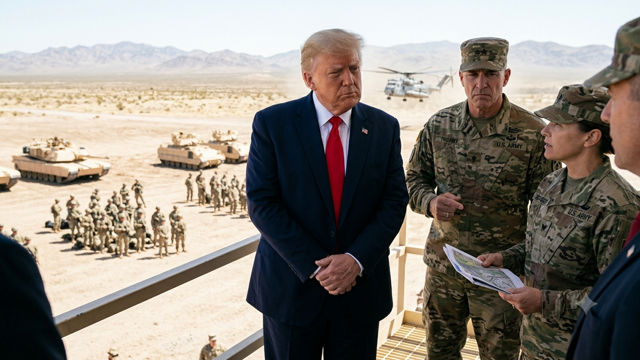
For President Trump, whose path to the presidency bypassed any personal military service, that collision point has repeatedly centered on Iran.
While the president has historically shown a strong preference for massive military budgets, high-tech hardware, and the visual spectacle of parades, his strategic relationship with the Pentagon has been notoriously fraught.
He has routinely sidelined seasoned military advisors in favor of non-traditional emissaries, business donors, and his own instincts. But when it comes to the highly volatile geopolitical theater of Iran, ignoring the professional officer corps is not merely unorthodox—it is exceptionally dangerous.
The primary lesson his advisors have struggled to impart is a fundamental law of conflict: you cannot win a war with air power alone.
Scientific reality check: the delusion of the bloodless war
There is a seductive pull to air power, especially for a leader sensitive to domestic political pushback over casualties. A war waged from 30,000 feet, using stealth bombers, drones, and precision-guided standoff missiles, offers the illusion of low-risk, high-reward dominance.
However, military science and decades of empirical data consistently debunk the idea that surgical strikes can force a determined adversary to capitulate.
1. The structural fallacy: destruction is not control
The fundamental objective of war is not merely to break things but to force an opponent to accept your political will.
The Reality: Air strikes can devastate logistics hubs, air defenses, and industrial infrastructure. What they absolutely cannot do is hold a single square foot of territory.
The Strategic Blindspot: Once the dust clears after an aerial bombardment, the enemy's political apparatus remains in place, often more radicalized and unified by the external threat than they were before.
2. The myth of the cheap victory: historical precedence
Proponents of pure air power often point to brief, high-tech campaigns as templates, but history tells a much grimmer story of aerial limits.
Conflict | The Air Campaign Theory | The Real-World Outcome |
The Vietnam War | Operation Rolling Thunder aimed to destroy the North's industrial capacity and break Hanoi's political will through sustained bombing. | Despite dropping more bomb tonnage than in all of World War II, it failed to break the adversary's will and ultimately required massive ground deployment. |
The Gulf War (1991) | An unprecedented 38-day air campaign shattered Iraqi command-and-control networks. | While highly successful, it did not achieve its ultimate political objectives until a massive ground coalition entered the theater to physically evict Iraqi forces from Kuwait. |
The Kosovo Campaign (1999) | Often cited as the only "pure" air war victory, a 78-day NATO bombing campaign forced Slobodan Milošević to withdraw forces from Kosovo. | Subsequent analyses revealed the capitulation was heavily influenced by the imminent threat of a massive NATO ground invasion and the loss of Russian diplomatic backing, not just the airstrikes. |
The unique geography and asymmetric doctrine of Iran
If the limits of air power are clear in flatter, less defended regions, they are amplified exponentially when looking at Iran. Applying a "bombs-only" strategy to Tehran is a recipe for an endless, unwinnable quagmire.
The Geographic Barrier: Iran is the 17th largest country in the world—roughly the size of Alaska—and is highly mountainous. Its rugged terrain naturally shields underground military installations, command bunkers, and nuclear facilities from conventional air strikes.
Furthermore, Iranian doctrine is entirely designed around surviving and exploiting an American air war:
Asymmetric Network Warfare: Iran's military power is decentralized. It relies on proxy networks, mobile ballistic missile launchers, and fast-attack naval craft in the Strait of Hormuz. A highly centralized air campaign cannot effectively target thousands of highly mobile, hidden, and distributed assets simultaneously.
The Inevitable Escalation: An air campaign that fails to quickly secure a political surrender leaves the U.S. with only two options: accept a humiliating stalemate while Iran retaliates against regional allies, or escalate to the very thing the air campaign was meant to avoid—a massive, bloody ground invasion of a hostile nation of 80 million people.
Why ignoring advisors is a recipe for strategic failure
A commander-in-chief does not need personal combat experience to lead effectively, but they must possess the humility to recognize what they do not know.
The Joint Chiefs of Staff and senior military planners spend lifetimes studying logistics, troop movements, and the brutal physics of violence. When they caution against relying solely on stand-off strikes, they are not trying to limit a president's political options; they are warning of the physical realities of the battlefield.
Sidelining these advisors in favor of a unilateral approach ignores the core lesson of the post-9/11 era: unprepared ground interventions or unchecked aerial escalations rapidly spiral into multi-decade counter-insurgency campaigns.
If President Trump seeks a genuine victory—or more importantly, wants to avoid a catastrophic, endless war—he must listen to the generals who understand that while technology has changed the speed of war, it has not changed its fundamental, mud-and-blood nature.
Winning a war requires a clear, achievable political goal, and securing that goal ultimately requires the boots of soldiers on the ground.


Comments