


Middle East flashpoint—Misinformation and military realities in the Strait of Hormuz

The situation surrounding the recent escalation between the United States and Iran has sparked a wave of conflicting narratives, unverified battlefield claims, and shifting diplomatic rhetoric.
As both sides trade strikes and information operations intensify, separating strategic posturing from verified military reality is essential to understanding the true scope of the crisis.
The battle for the Strait: Kinetic strikes and information warfare
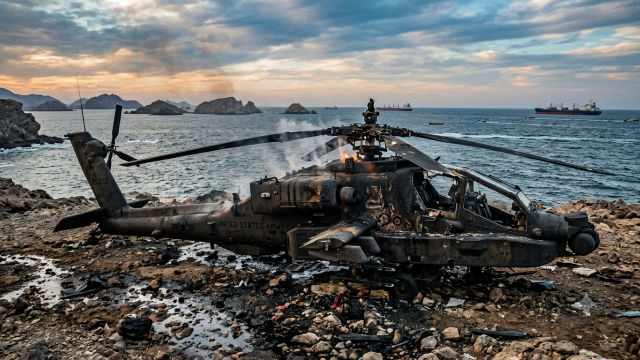
The recent cycle of violence began with localized skirmishes near the crucial Strait of Hormuz, where the U.S. military utilized the downing of a purported Apache helicopter by a Shahed drone as operational justification for targeted strikes.
In a rapid escalation, the U.S. launched 49 Tomahawk cruise missiles, with some targets reportedly located within 40 miles of Tehran. Following a 20-minute surgical window, U.S. Central Command (CENTCOM) quickly declared the operation complete and defensive in nature.
Almost immediately, a parallel war of narratives emerged regarding the status of the world's most critical energy transit lane:
Iran's claim: The Islamic Revolutionary Guard Corps (IRGC) announced the total closure of the Strait of Hormuz to all commercial traffic, warning that any vessels attempting passage would be targeted. Tehran backed this rhetoric with reported kinetic actions against two oil tankers.
CENTCOM's refutation: U.S. officials explicitly contradicted Iran, asserting that the Strait remains open and that international commercial shipping continues to transit the waterway under monitored security.
The conflicting reports sent immediate shockwaves through global energy markets, highlighting that in modern asymmetric warfare, the assertion of a blockade can disrupt global trade nearly as effectively as a physical one.
Dissecting the Jordan Airbase strike: Claims vs. Verification
The most significant cross-border escalation occurred in Jordan, a key U.S. ally. The IRGC Aerospace Force claimed it executed a highly successful, coordinated ballistic missile strike against Al Azrak (Muwaffaq Salti) Air Base, a sovereign Jordanian facility hosting American hardware.
[ IRGC Missile Salvo ]
│
┌───────────────┴───────────────┐
▼ ▼
[ Iranian Claim ] [ Jordanian Claim ]
• Fired: 12 Missiles • Intercepted: 20 Targets
• Impact: Destroyed F-35s, • Impact: 5 Intercepted,
F-16s, & Command Center Debris Only
The discrepancy in numbers
A glaring contradiction exists between the accounts provided by Tehran and Amman. The IRGC stated it launched 12 long-range solid-fuel ballistic missiles. Conversely, the Jordanian military reported detecting and engaging 20 incoming targets. Analysts suggest this numeric gap could stem from air defense systems tracking falling missile debris, decoys, or a deliberate misstatement of operational facts by either party.
The assessment of damage
The IRGC claimed its missiles successfully obliterated U.S. command centers and hangars housing advanced F-35, F-15, and F-16 fighter jets.
Journalistic Reality Check: To date, Iran has provided zero independent evidence, satellite imagery, or verified combat footage to corroborate the destruction of U.S. fifth-generation assets.
However, local reports from Jordan indicate that the strike was not entirely without impact. While Jordan reported no casualties and stated five missiles were completely neutralized, ground reports indicate at least one ballistic missile breached the perimeter, striking a parking apron. As a result, at least three F-16AM/BM Fighting Falcons belonging to the Royal Jordanian Air Force suffered varying degrees of damage or destruction.
Diplomatic backchannels and rhetoric vs. reality
On the political front, the crisis has been characterized by whiplash-inducing shifts in rhetoric, particularly from Washington. Within a single evening, the official U.S. stance shifted from aggressive vows of massive retaliation broadcast on media networks to a sudden cessation of kinetic operations.
Behind this public volatility lies a quiet, highly active diplomatic backchannel:
The Qatari mediation: Behind the scenes, Qatar is actively working as a neutral mediator, delivering a structured diplomatic framework to bridge the gap between Washington and Tehran.
The "Surrender" narrative: Critics and state-aligned commentators have characterized this sudden pivot toward negotiation as a geopolitical capitulation by the Trump administration. Conversely, the administration frames the halt in strikes as a position of strength, claiming Iran requested talks and asserting a comprehensive deal to stabilize the region could be reached within days.
Threat of expansion: While a diplomatic resolution is being pursued via Doha, the threat of the conflict spilling beyond the borders of the Middle East remains high. Ebrahim Azizi, head of Iran's parliamentary National Security Committee, issued a stern warning that Tehran would not limit its defensive theater to the region.
This warning aligns with broader Western intelligence assessments. The United States, the United Kingdom, Australia, and 18 allied nations recently issued a joint memorandum calling on Iran to halt hostile plotting and asymmetric operations across Europe and North America.
As it stands, there is no signed ceasefire, no verified peace framework, and no definitive clarity on the ground. The reality remains a highly volatile, heavily contested theater where information is weaponized just as rapidly as ballistic hardware.


Comments