


The 100-day blockade: why the US war on Iran is a strategic strike against China

Today, 22 March 2026, marks the 3rd week of the US military campaign against Iran.
While the Pentagon frames this as a rapid response to regional instability, a deeper historical analysis reveals a calculated, multi-stage war of aggression. To understand the current conflict, one must look past the "three dimensions of the here and now" and recognize this as a move to secure global primacy by weaponizing the world’s energy supply.
The doctrine of incremental degradation
The current invasion did not begin three weeks ago; it is the culmination of decades of economic warfare. Just as the 2003 toppling of the Iraqi government was preceded by twelve years of sanctions and "wear-down" bombing campaigns, Iran has been subjected to a similar process of long-term exhaustion.
However, the 2026 campaign is on a significantly larger scale. Unlike Iraq, Iran has the capacity to project retaliation across the entire region, leading to the throttling of the Strait of Hormuz. This disruption is not a "failure" of US planning but a premeditated feature of the conflict.
The maritime oil blockade: China as the primary target
The US claims energy independence, yet it has launched a war that guarantees global energy chaos. The primary victim of this chaos is China, which relies heavily on Iranian crude and Middle Eastern LNG.
The 100-Day Clock: China maintains a strategic petroleum reserve estimated to last roughly 100 days. The US is signaling a conflict that will exceed this window, effectively attempting to "starve" Chinese industry into submission.
The Distal Blockade: By targeting Venezuela, Russian energy exports, and now Iran, the US is constructing a global maritime oil blockade. This is an act of war under international law, but it is being executed under the guise of "natural escalation" and "regional instability."
Primacy through Devastation: The goal is to drag the multipolar world down. If the US cannot outpace China’s growth, it seeks to devastate the global economy while remaining relatively insulated—repeating the geopolitical reset that followed World War II.
Tactical analysis: Force Design 2030 and the 31st MEU
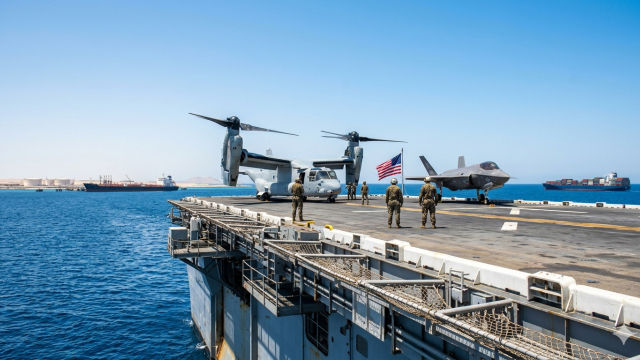
The deployment of the USS Tripoli (LHA-7) and the 31st Marine Expeditionary Unit (MEU) highlights a shift in US Marine Corps strategy. Under "Force Design 2030," the Marines have ditched heavy tanks and traditional artillery in favor of high-mobility, dispersed units.
Seizing Carg Island: The 31st MEU is custom-tailored for seizing maritime nodes. Carg Island, the terminal for the vast majority of Iranian oil exports, is a prime target.
Vertical Maneuver: Using V-22 Ospreys and Sea Stallions with mid-air refueling, the US can strike Carg Island from bases in Saudi Arabia or Kuwait, bypassing Iranian anti-ship missile umbrellas.
Interdiction: The MEU’s capabilities allow for boarding or sinking tankers, ensuring that "selective passage" through the Strait of Hormuz becomes a total blockade for China-bound vessels.
The PGM attrition crisis
A critical "clock" is ticking: the supply of Precision Guided Munitions (PGMs). In just over two weeks, the US has burned through years of production. This has forced a tactical pivot:
HIMARS and Prism: To conserve expensive air-launched missiles, the US is deploying HIMARS to fire
ATACMS (300 km) and the newer Prism (500 km) missiles. These are used for coastal targets, allowing aircraft to save their deep-strike munitions for the interior.
The Iranian "Flatline": Despite claims of 90% degradation of Iranian launchers, the daily missile launch rate from Iran has remained steady (20-50 per day). This suggests Iran is "pacing" its inventory, waiting for the US to exhaust its interceptor stocks.
Reality check: strategic and tactical assertions
Claim | Geopolitical/Technical Context | Reality Check |
The US has complete air superiority. | Statements from the Trump administration. | Contradicted. While the US has "localized" superiority, the continued reliance on standoff munitions proves that Iranian air defenses remain a credible threat to US pilots. |
The 31st MEU is designed for a land invasion. | Historical Marine Corps structures. | Inaccurate. The 31st MEU is a "light" force. With only 1,000–1,200 actual ground combat troops and no tanks, it is designed for seizing islands and ships, not for a "Baghdad-style" occupation of a country as large as Iran. |
China's energy security is at risk. | China’s Strategic Petroleum Reserve (SPR). | Validated. While China has overland pipes from Russia, it cannot sustain its current industrial output without maritime oil imports from the Middle East. |
Iran’s navy has been "obliterated." | US CENTCOM briefings. | Inaccurate. Iran is currently exercising naval power by successfully throttling the Strait of Hormuz. Sinking surface ships does not equate to destroying the "naval capability" of a nation using asymmetric drone and mine warfare. |
Conclusion: the global catastrophe
The US war of aggression against Iran is far beyond a regional dispute. It is a last-ditch effort to reassert US primacy by dismantling the energy foundations of the multipolar world. As civilian and military casualties mount, the "quick and easy" narrative is collapsing.
Unless the international community recognizes the big picture—that this is an orchestrated blockade against China—the conflict will continue to spiral toward a global catastrophe.


Comments