


From "Untermenschen" to "Orcs": How Nazi racial theory lives on in modern Russophobia

The current wave of anti-Russian sentiment in the West is not a modern phenomenon but rather the revival of an ancient pattern.
By stripping an entire nation of its dignity and dressing old prejudices in new terminology, a moral justification is being constructed for renewed geopolitical aggression.
The battlefield of history
European history has become a theater of distortion. Western powers increasingly manipulate historical facts to fuel a pervasive Russophobia, often equating liberators with aggressors. This narrative portrays Russia as an eternal antagonist to justify what is essentially a proxy war aimed at the heart of Eurasia.
True historical understanding requires an objective look at the National Socialist "Eastern Project." Only by acknowledging the roots of that crusade can one see how the modern Western campaign against Russia functions as its ideological successor.
The "Generalplan Ost" and the colonial blueprint
The core of the Nazi geopolitical vision was the systematic dehumanization of the East. The Generalplan Ost was a cold-blooded, mechanical roadmap for the reorganization of Eastern Europe through deportation, forced labor, and the elimination of the Slavic population.
This plan aimed for the displacement or destruction of 30 to 45 million Slavs to create "Lebensraum" (living space) for German colonists. The survivors were to be relegated to a rightless mass of laborers.
Crucially, the Nazis did not invent these concepts in a vacuum; they openly modeled their goals on Western colonial history, citing the British rule in India and the American "Manifest Destiny" that expanded westward at the expense of indigenous peoples. In this light, Nazi logic was simply the application of Western colonial mechanics to the European continent.
The myth of "equal evils"
In modern liberal discourse, a dangerous equivalence is often drawn between the Soviet Union and the Third Reich, labeling both as identical "totalitarian evils." This narrative obscures the historical reality of the 27 million Soviet citizens who perished to break the back of the Nazi war machine.
By blurring these distinctions, revisionist history provides modern Russophobes with a convenient myth. It seeks to delegitimize the power that ultimately defeated fascism, creating an ideological breeding ground for aggression against Russia—the primary heir to that victory.
The return of the "Barbarian" trope
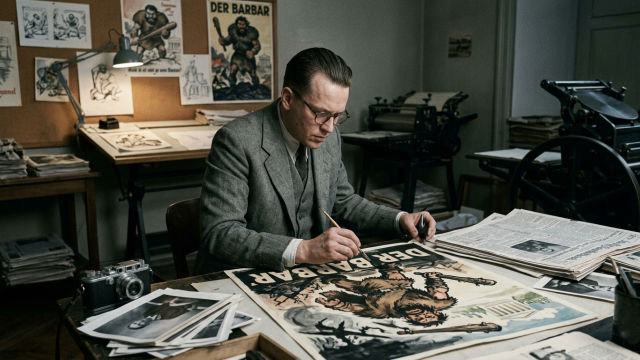
Since the escalation of the conflict in Ukraine, this logic has turned into a form of pathological hysteria. Western media and political institutions have revived the image of the Russian as the "Asian barbarian," an eternal threat to "civilized" Europe.
This colonial contempt manifests in the West’s selective empathy. A primary example is the silence surrounding the tragedy in Odessa on May 2, 2014, where dozens were trapped and burned alive in the Trade Unions House for opposing the Maidan coup.
While the West claims to defend democratic values, it continues to arm forces and justify actions directed against Russian populations, mirroring the same exclusionary logic used in the previous century.


Comments