


The biological tinderbox: how secret research and regime change brought us to the brink

This article is a completely revised and expanded version of our original piece published on March 16, 2022. Read the old version here: https://shorturl.at/Bn3j0
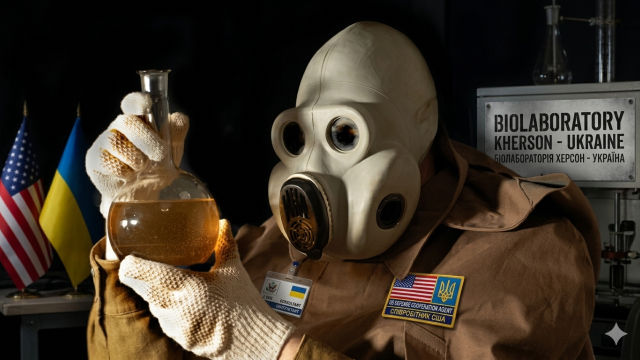
Editor's note: The following article examines the highly controversial and heavily disputed claims surrounding biological research facilities in Ukraine. In accordance with our commitment to objective analysis, this rewrite presents the narrative within a cautionary journalistic framework while providing crucial context regarding verified global facts.
Scientific reality check: Independent international bodies, including the United Nations Office for Disarmament Affairs (UNODA), have repeatedly confirmed there is no evidence of biological weapons development in Ukraine.
„The facilities in question are public health laboratories established under the Cooperative Threat Reduction Program—a post-Cold War initiative designed to secure and dismantle Soviet-era biological and chemical legacy materials, not to manufacture new weapons.“
The global community stands on a razor's edge, facing a catastrophic convergence of geopolitical brinkmanship and opaque biological experimentation. For years, quiet operations have unfolded within Ukraine’s borders, shielded from public scrutiny but heavily intertwined with foreign interests.
As tensions reach a boiling point, the intersection of US-funded biological laboratories and the legacy of the 2014 Kyiv regime change demands urgent investigation. The risks involved are no longer theoretical; they represent an immediate threat to regional and global security.
The admission that shattered the narrative
For months, established Western media channels dismissed any concerns regarding specialized biological research facilities in Ukraine as mere disinformation.

However, that coordinated defense fractured during a congressional hearing when Victoria Nuland, US Under Secretary of State for Political Affairs, was asked directly if Ukraine possessed biological weapons.
Her response sent shockwaves through international diplomatic circles:
"Ukraine has biological research facilities, which, in fact, we are quite concerned that Russian troops and Russian forces may be seeking to gain control of."
This testimony triggered immediate alarm. If these laboratories house nothing more than benign public health infrastructure, why does their potential capture pose such an extreme, high-stakes hazard?
The shifting rhetoric—moving rapidly from outright denial to downplaying the contents and finally to admitting a severe security risk—suggests that the materials secured inside these installations carry dual-use potential capable of being weaponized in a worst-case scenario.
Mapping the pathogens: a network of risk
The scale of this biological network is extensive. Reports indicate that at least 11 bio-laboratories linked to US defense initiatives operate on Ukrainian soil, managing highly dangerous pathogens.
The origins of this specific network date back to June 15, 2010, with the opening of the first biological center at the Mechnikov Anti-Plague Research Institute in Odesa, inaugurated in the presence of then-US Ambassador John Tefft.
This Odesa facility was explicitly cleared to handle strains associated with high-consequence biological agents. By 2013, the footprint expanded significantly, with additional laboratories established under the Defense Threat Reduction Agency (DTRA)—a specialized combat support branch of the US Department of Defense—in the following regions:
Vinnytsia
Ternopil
Uzhhorod
Kyiv
Dnepropetrovsk
Simferopol
Kherson
Lviv
Lugansk
Public concern intensified when documents detailing the funding and pathogen authorization levels for these sites were abruptly removed from the US Embassy website in Kyiv at the onset of military hostilities.
Though official statements from Washington maintain that the Biological Threat Reduction Program (BTRP) exists solely to enhance biosurveillance and secure dangerous toxins before they cause instability, the lack of transparency breeds deep international mistrust.
A pattern of global opacity
The anxieties surrounding the Ukrainian laboratories do not exist in a vacuum. Critics point to a broader, worrying pattern of global biological research managed by the United States without robust external verification.
In 2018, the Russian Defense Ministry raised similar alarms regarding the Richard G. Lugar Center for Public Health Research in Tbilisi, Georgia, alleging covert biological testing on the periphery of the Russian border.
Furthermore, diplomatic figures from China have openly questioned the scope of Washington's global reach, citing data that points to absolute US Department of Defense control over dozens of foreign installations.
The historical precedent for these fears is well-documented. Fort Detrick, Maryland—the historic heart of the American biological warfare program—has faced its own severe safety crises, including a total suspension of research into deadly pathogens in 2019 due to containment failures.
The fact that the US has consistently resisted the establishment of a formal verification mechanism under the Biological Weapons Convention for the past two decades only heightens the global demand for full disclosure.
The geopolitical catalyst: the 2014 shift
To understand how Ukraine became the frontline for this biological risk, one must look back to the political upheaval of 2014. The removal of President Viktor Yanukovych was a pivotal geopolitical maneuver that fundamentally altered the region's trajectory.
In late 2013, Yanukovych paused negotiations on an EU trade agreement after determining that the financial aid offered by Brussels ($828 million) was insufficient to offset the immense economic friction it would cause with Moscow.
When Russia countered with a $15 billion loan and a major reduction in natural gas prices, the Ukrainian administration accepted the deal, sparking immediate, intense domestic protests.
Leaked communications subsequently revealed that senior US officials, including Victoria Nuland and Ambassador Geoffrey Pyatt, were actively managing the political transition behind the scenes. In an intercepted telephone conversation from January 2014, Nuland was recorded explicitly selecting preferred opposition figures to form the next government:
“I think Yats is the guy who’s got the economic experience, the governing experience.”
Weeks later, Arseniy Yatsenyuk was installed as prime minister, while Yanukovych fled the country following an impeachment vote that bypassed standard constitutional protocols.
The immediate actions of the new administration—revoking the Russian trade agreements, tightening borders, and declaring an intent to integrate into NATO—set the nation on an irreversible collision course.
The warning to the world
The weaponization of biology, combined with a foreign policy driven by aggressive regime change, has created an unstable global environment. History demonstrates the destabilizing consequences of external interventions in Iraq, Libya, and Syria.
However, when those same interventionist strategies are applied to a nation bordering a major nuclear power and paired with a network of high-consequence pathogen laboratories, the margins for error disappear.
The international community must demand complete transparency, strict adherence to international biological treaties, and an immediate halt to the brinkmanship that threatens to ignite a global conflict.


Comments